


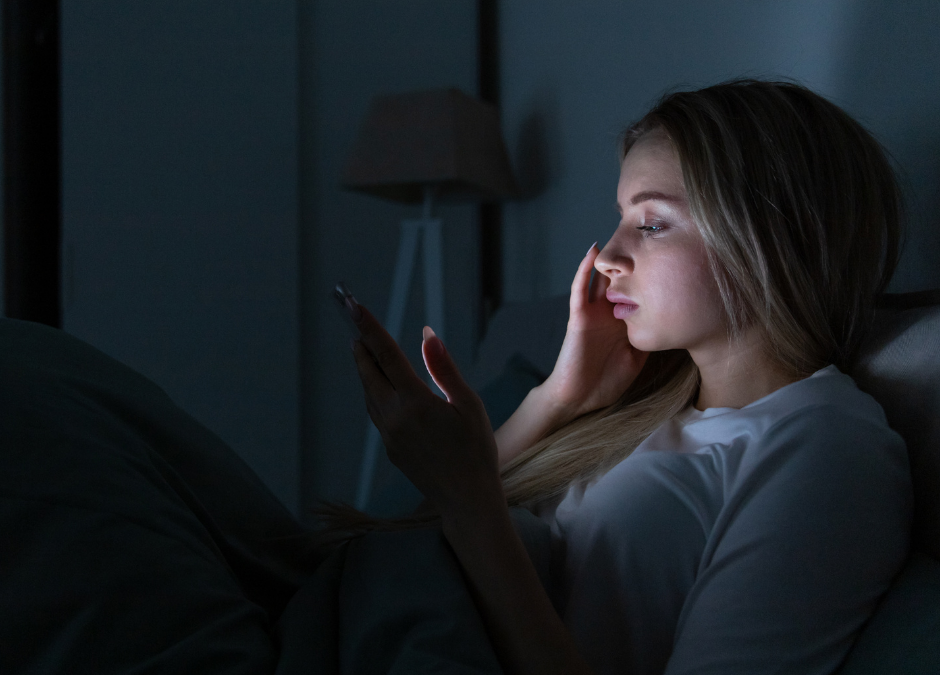
One of the most significant threats to modern sleep is our attachment to screens. Phones, tablets, televisions, and computers emit blue light, which suppresses melatonin and delays the body’s natural preparation for sleep. Studies show that even 30 minutes of screen exposure before bed can lead to longer time falling asleep, more nighttime awakenings, and less restorative sleep.
This is not just a theory. Research confirms that using light-emitting devices such as eReaders or phones in the hour before bed negatively affects next-morning alertness and disrupts circadian rhythms. Setting your phone to grayscale can help reduce its visual appeal and decrease compulsive scrolling. One study found that users who enabled grayscale mode on their devices spent significantly less time on social media and showed greater self-regulation at night. Counselor Sarah shares, “Many of us enjoy staying connected through our phones or tablets. This is something not just as adults we enjoy, but our children do too. Starting to dim the lights in our house earlier, turning the volume down on the tv or switching to a physical book/puzzle can greatly support us all getting a more rested sleep at night. Little changes can make a big difference over time!”
The best strategy is to reduce screen time 60-90 minutes before bed. Instead, try reading a print book, listening to calming music, or practicing a wind-down routine that supports your body’s transition to sleep.
Dr. Garrett’s Sleep Resources
- Dr. Garrett’s Step-by-Step Sleep Guide_ How to Go from 5 to 8 Hours of Sleep per Night
- Dr. Garrett’s Top Sleep Recommendations
Recommended Books:
- Price, D. (2018). The power of off: The mindful way to stay sane in a virtual world. St. Martin’s Press.
- Dodgen-Magee, D. (2018). Deviced!: Balancing life and technology in a digital world. Rowman & Littlefield.
Recommended Blog/Website:
- HelloSleep.com: Education and courses from Dr. Jade Wu
References:
Brainard, G. C., Hanifin, J. P., Greeson, J. M., Byrne, B., Glickman, G., Gerner, E., & Rollag, M. D. (2001). Action spectrum for melatonin regulation in humans: Evidence for a novel circadian photoreceptor. The Journal of Neuroscience, 21(16), 6405–6412. https://doi.org/10.1523/JNEUROSCI.21-16-06405.2001
Chang, A. M., Aeschbach, D., Duffy, J. F., & Czeisler, C. A. (2015). Evening use of light-emitting eReaders negatively affects sleep, circadian timing, and next-morning alertness. Proceedings of the National Academy of Sciences, 112(4), 1232-1237. https://doi.org/10.1073/pnas.1418490112
Holte, A. J., & Ferraro, R. (2020). True colors: Grayscale setting reduces screen time in college students. The Social Science Journal, 60(2), 1-17. https://doi.org/10.1080/03623319.2020.1737461
Zeitzer, J. M., Dijk, D. J., Kronauer, R., Brown, E., & Czeisler, C. A. (2000). Sensitivity of the human circadian pacemaker to nocturnal light: Melatonin phase resetting and suppression. The Journal of Physiology, 526(3), 695-702. https://doi.org/10.1111/j.1469-7793.2000.00695.x